


I Can’t Unsee Them
By Siobhan M. Griffin

You have all seen the textbook drawing that depicts the succession of plants in temperate environments like ours – first lichen and moss colonize new ground and then annual forbs (weeds) appear. Soon newly established perennial grasses get invaded by shrubs and then dwarf trees. Eventually the ecosystem self organizes to closed canopy forest. That is what is supposed to happen, right? Think again.
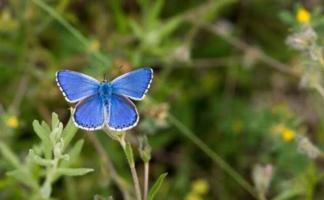
Back in 2014 my farm gave me clues about what should be covering our hills when I saw five Karner blue butterflies on a cow pie in the laneway of my farm. I knew they were rare and endangered because they had been our poster child when I joined people who were protesting the bulldozing of 175 acres of pinebush habitat near Albany, NY to build the Crossgates Mall in 1984. Thirty years later they had showed up on my farm. I was sure it was a message from God sent to encourage me to continue with the holistic management of my farm. After all, in the story of Noah’s Ark, God had wanted every species of animals to go forth and multiply after the flood.
But why had Karner blue butterflies come? After all, they are prairie species just like the ground-nesting bobolinks that had also moved on to Raindance Farm in abundance. This sent me on the inquisitive journey that has resulted in my new book Sun Cheese: Lessons From Regenerative Farming That Can Help You Rewrite Your Future. Organic dairy farmers like you already understand the essential symbiotic relationships between your livestock and the plants they fertilize and prune. I wrote Sun Cheese for the environmentally concerned friends and relatives you meet at family get-togethers and markets who tell you livestock are bad for the planet.
That scenario of succession is missing something critical – animals. According to The Creator’s ingenious design, there is no ecosystem on Earth that evolved without animals. The big ones that weigh over 100 lbs, known as megafauna, evolved on every continent. We are so used to landscapes that are depleted of their megafauna that we think the shift to dense forest on our landscapes is normal. But this is not what our Paleolithic ancestors found thousands of years ago when they arrived to pristine ecosystems on continents around the world outside of Africa.
In the eastern US where we farm, the landscape as recently as 11,000 years ago was kept open by giant ground sloth, some as big as African bull elephants. They, along with their supersized friends the bison, mammoth, American horse, and mastodon were landscapers who pruned and mowed the land in a way that produced incredibly productive open woodlands that teemed with grazers and browsers. Why should we care today? Because the result has been many more wildfires and less productive landscapes.
Wildfire
When humans hunted scores of species of megafauna to functional extinction in North and South America between 22,000 and 11,000 years ago, more charcoal appeared in soil sediment cores from back then. Wildfire had become more frequent. Why? Because the unnatural succession you see in the textbooks occurs only in the absence of the large grazers and browsers that had coevolved with all our native plants. Now, under closed canopy forests, more brush accumulates because the giant ground sloths and 30 other species of sloth were not stripping the leaves for food and trampling the woody material to the ground where fungi could easily recycle it. Bushes create “ladders” that allowed fires to spread to the tops of trees. The closed forest canopy with trees close together creates a superhighway for wildfire. Now, when I see wildfires on the news, I cannot unsee the giant sloths!
There are more reasons you should care about the giant animals called megafauna. One is the fact that you raise them. Livestock like cattle and sheep are technically megafauna and as such can be used to mimic the ecosystem service that wild megafauna once provided when they enjoyed the earth in abundance as God had intended. Silvopasture, where livestock are raised in open woodlands that mimic our pristine ecosystems, can be a useful tool to create agroecosystems that are more resistant to fire.
When my parents were young in the 1940s and 50s, livestock covered the European landscape where they grew up and kept nutrients like carbon cycling and plants fresh, green and growing. Since then, most livestock have been removed from European and American landscapes and put in CAFO’s. Crops are grown to feed the animals but in the area that is not in crop, such as on steeper land or abandoned land near towns and cities, the unnatural succession to closed canopy forest has occurred and made bigger and more dangerous wildfires inevitable. These become more likely to occur in the hot dry weather that is becoming more frequent. In Canada, the 2023 fire season was so bad that the forestry sector emitted more greenhouse gases that the entire fossil fuel industry. The blazing forest fires are occurring on land once grazed by three species of bison, including the giant Steppe bison, along with giant elephants.
More Productivity per Unit of Input
The other reason to learn about the ecology of Pleistocene megafauna is the template of exceptional productivity they offer. These can be copied by regenerative organic farmers today to make our farms more profitable. For instance, one acre of silvopasture can produce 40% more food than either one acre of pasture or one acre of orchard alone. If you really want to speed up nutrient cycling on your farm, the logical way to mimic how nature did it is by adding more species of animals, be they wild or domestic.
Poultry are a logical place to start because birds were once far more abundant in the open woodlands of the Eastern US. The naturalist John James Audubon testified in 1813 that one flock of passenger pigeons in Kentucky flew overhead for three days. The flock size was estimated to be over two billion birds. He said in his writing that “the dung fell in spots, not unlike melting flakes of snow.” Abundant birds were driving the nitrogen cycle and the land produced more than today without any artificial fertilizer. It looks like nature had abundance all figured out. The farther back you look, the further forward you can see.
Siobhan Griffin was an early adopter of organic dairy farming and a holistic management practitioner. She farmed in Vermont and New York State from 1991 to 2016. She served many years as a New York State Representative with NODPA. Upon selling Raindance Farm, she moved to New Zealand and now lives with her partner of ten years, Rick, on a thousand-acre sheep farm. She coaches regenerative dairy and livestock farmers through her consulting business Next Level Grazing, ltd. Learn more about her new book at www.restoracene.com.
Posted: to Organic Production on Sun, Sep 6, 2026
Updated: Sun, Sep 6, 2026